Cells:
Cells are living things that make up organisms. they can be an organism or can be part of one. For example bacteria cells are an organism and a cheek cell is not. Plant and animal cells are eukaryotic and a bacteria cell is prokaryotic. Some organelles of an animal cell are ; cell membrane, cytoplasm, nucleus, and mitochondria. A plant cell has thos too plus it has chloroplast and a cell wall. Bacteia cells have cell walls, mitochondria, and DNA.
Respiration:
Respiration is breathing, it is the way organisms make energy. the reactants of respiration are oxygen and carbohydrates ( food ). these reactants are the products of photosynthesis. The products of respiration are water and carbon dioxide. These are the reactants of photosynthesis. When we do not have enough oxygen we begin to get cramps which are signs that there isn't enough.
Photosynthesis:
Only plants go through photosynthesis. Photosynthesis is the process in which plants create there own food. The gases that enter and leave the plant go through the stomata under the leaves on a plant. Water comes in through the roots of the plants.
Fermentation:
The process of making energy without oxygen. The reacvtants are sugars and the products could be either lactic acids or alcohal.
ProteinSynthesis:
The process of creating proteins. It begins with the copying of DNA to make mRNA. The mRNA is taken to the ribosomes where the ribsomes put the mRNA strand and the amino acids to create a protein strand.
Monday, December 21, 2009
Saturday, December 12, 2009
Protein Synthesis
Protein synthesis is what rna makes.
1)The DNA copies the RNA
2) The RNA finds the other base pairs
3) Adonine is always matched with Uricil in RNA
4) Codons ( groups of base pairs-amino acids) come together
5) They form protein
The DNA begins the process by hinking of an idea. The DNA comes up with instructions on his idea, then RNA makes a copy of it. Then the rna goes through transcription, the copying to make mRNA. The codons come together to make a protein. Something like this:
U.A.A.U.G.C.U.A.G.A.C.G.U.G.U.U.C.U.A.G.G.A
^^^^^^^^^^^^^^^^^^^^^^^^^^^^^^^^^^>>>>>mR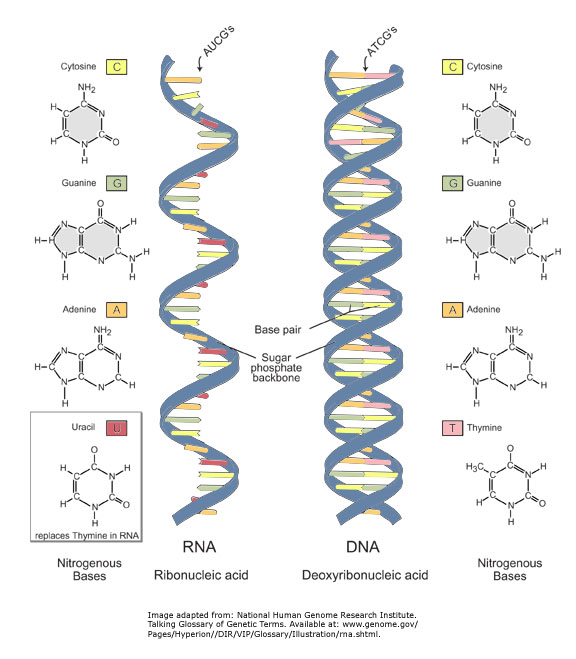 NA
NAthe the adonie codons come together to form the protein after the ribosomes tell them what to do and how to organize themselves.
Saturday, November 7, 2009
Blog 11/9/09 MY BIRTHDAY WHOOOT WHOOT


This week i learned a lot. I learned about the structure and functions of animal and plant cells. I learned about the organelles that are part of these two cells. Also i learned the functions of the organelles. We did some experiments on bnoth plant and animal cells. What we did was that we took swabs of the inside of our mouths ( cheeks ) and made a slide of it and looked at our cells under the microscope. we were in groups of two one person added die to their slides. With the die we could see the organelles and the cell better. Then we did some test on plant cells. We cut small tiny slices of potato and looked at it under the microscope. For this one we had to make three slides one was with water, another was with blue die, another was with lugo and then we had one last slide but it was of grass. The last thing we did was get some of the grass water to see if it hads any paremicium. It is important to know these things for scientific research.
Sunday, October 25, 2009
homework
I learned a lot this week. We learned about gram negative and positive. My group was first to do the experiment it was really cool. Although it was cool we made a mistake and it didn't work that well. Their are four possible diseases that the chicken could have held. Two of wich are gram negative like our chickens gram. the two that were gram negative are salmonella and campylobacter. It is good to know these stuff for when or if you become a doctor.
Monday, October 19, 2009
homework
We did our experiments on chicken and pond water etc. We found a lot of good interesting things in our observations. TRhe pond water had moving organisms that may or may not be water flees. We know a lot about the things we got now.
Monday, October 12, 2009
10/8/09
I've learned alot in science this past week. I learned about different ways to experiment on things. Also i learned about the structures of bacteria and viruses. By learning about there structures i got to support my thought on bacteria being living and viruses being dormant. I also learned a little about microscopes and slides. Now i Know how to make dry mount and wet mount slides. Another thing i learned about is how to test different things like in what form to test things. It is important to know all of these things to prove diseases and it is important to know how to test things. Also it is important to know how to use a microscope like if you are a doctor or scientist.
Saturday, October 3, 2009
7th, Fri 10/4 - Blog

What science ideas did you learn?
I learned alot this time. I learned more about hypothesis, predictions, tests, causes of illness, Bacteria, parasites, fungus, and viruses. I also learned some new things to like i learned about what microscopic, mocroscopic, and sub-microscopic mean. Microscopic means small. Mocroscopic is big and sub- microscopic is really small. Somethings that are microscopic are red blood cells and dust mites. Two thing that are mocroscopic are fingers and pins. And an example of sub- microscopic is rhinovirus.
How did you learn these ideas?
I learned these ideas by doing many things. i learned about the scopics by looking at a simulation called how big... I'm still learning about bacteria waiting for our experiment to be final. We went to the bathroom and collected swabs of one non-bacterialized thing and one bacterialized thing in the bathroom.
Why is it important to know this idea (What real world application is there)?
It is good to know these things because what if you were a doctor and you had to know wether or not you will be able to see something under a microscope. It is god to also know how to deal with bacteria and how to see bacteria.
Monday, September 28, 2009
Homework Fri 9/25
What science ideas did you learn?
I learned how to chategorize objects. Before when we had only 2 categories non living and living it was hard to choose. For example if you had seeds how would you know if they were living or non-living. my point is they could be both. By following all nine characteristics of life you can figure out exactly what it is. The nine characteristics are responses to stimuli, displays of heredity, need energy, grow and develop, respirates, composed of cells, ability to reproduce, and homeostasis.By knowing these characteristics you can check each one to see if the object has it all. Also, there are more then two categories, there is non-living, living, dead, and dormant. if i had to choose what seeds would be i would put them in as dormant because they aren't showing the characteristics at the moment but they still could by planting them.
How did you learn these ideas?
I learned these ideas by making a checklist. I would get different objects from mr.finley and then I went from there. I would check each characteristic that the object would show. or example a butterfly respirates, shows heredity,respons to stimuli, needs energy, grows and develops, is composed of cells, has the ability to reproduce, and shows homeostasis.
Why is it important to know this idea (What real world application is there)?
It's important because people need tt know this to know wether or not something is alive,not, dead, or dorment. like what if scientists found a new germ, these characteristics would help the scientists.
Friday, September 18, 2009
Science homework 9/18/09
What science ideas did you learn?
I learned that it takes work but that scientists have alot to do to find out about diseases. For example, to find out where the disease is hitting the scientists have to know what happens when you get it.Also, they have to know where it happens and what it does. They also need to know who is exposed in order to help them. Another thing they need to know is how the disease is caught like it might be caught by personal face-to-face contact or by an insect like a mosquito. They have hard work but they always do there best to help.
Other stuff i learned was how to make H-D statements, hypothesizes, predictions and to test the hypothesies. An H-D statement is a statement that includes If,And,Then in that order. The If is the hypothesies, the and is the expirement, and the THEn is the prediction. For exaple: IF Mr. Finley is clumsy so he haas 36 backup televisions and one is in use AND we check his garbage before garbage day THEN we should find at least one television. We also learned about independent and dependent variables. An independent variable is the variable that you change in an expirement. A dependent variable is the variable that changes as a result of the variable you changed.
How did you learn these ideas?
I learned these ideas by testing them out. we made a chart to find out how scientists find the start of a disease. We made hypothesies and tested them out to make our h-d statements. We studied ways to make our own H-D statements like the one in purple. To get that we had to be able to test it out. We learned the varibles by getting statements like : Metals expand when they are heated. The rate of expansion varies depending the type of metal. The independent variable is the type of metals and the dependent variable is the rate of expansion.
Why is it important to know this idea (What real world application is there)?
It is important to know all of this. Knowing about the diseases is important so people are treated corrctly. Knowing where and how it spreads is important to know so the scientists can study it and get the people in contact with it and who have it, get treated. Knowing how to make an H-D statemnt is important to real life because it is a way to test your hypothesy correctly. Scientists can use this t come to the right conlusion by disproving their hypotheies.
Subscribe to:
Posts (Atom)
